
Big Bag Filling Systems / Super Sack Loading Stations
Also known as...
FIBC filling station, Flexible container filling, Bulk Bag Packer
Do you have a question or remark? Please contact the author at admin@powderprocess.net
Top 5 Most Popular Equipment
- Rotary Airlock Valves - Air leakage & capacity sizing
- Screw Conveyors - CEMA power & volumetric throughput
- Cyclone Separators - Muschelknautz design efficiency
- Pneumatic Conveying - Dilute & dense phase velocity
- Silo & Hopper Design - Jenike mass flow critical outlet
1. What is a Big Bag filling station?
Big Bag filling stations (also termed Super Sack fillers, FIBC loaders, or bulk bag packers) fill flexible intermediate bulk containers with powders, fine chemicals, granules, and food ingredients across the bulk solids handling industries:
- Construction & minerals: Portland cement, hydrated lime, dry mortar, calcium carbonate, bentonite.
- Food & infant nutrition: Dairy powders, flours, starches, maltodextrins, refined sugar, cocoa powder.
- Chemicals & battery materials: Titanium dioxide, lithium carbonate, pigment powders, carbon black, fertilizers.
- Plastics: Polymer resin granules, masterbatches, ground regrind flakes.
Big Bags, also known as FIBCs (Flexible Intermediate Bulk Containers) or Super Sacks, are the most widespread industrial packaging for bulk solids. They can be used within a plant as internal process buffers or for domestic and export shipping. An optimal filling station must achieve three primary engineering criteria: accurate target weight, rapid cycle time, and total dust containment with balanced displaced air venting.
2. Design and Functional Subsystems of Big Bag Filling Stations
Designing a reliable FIBC loading station requires integrating structural, pneumatic, mechanical dosing, and de-dusting systems.
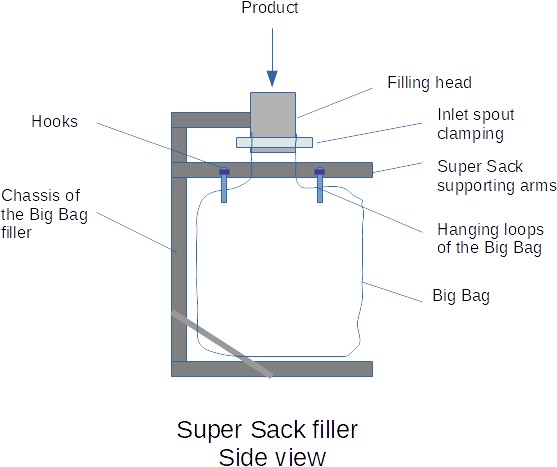
A. FIBC Dimension Compatibility & Telescopic Mast
Big bags range from 0.5 m³ to over 2.5 m³ in capacity with heights varying from 800 mm to over 2200 mm. Stations must feature an adjustable or pneumatically motorized telescopic mast to adjust the filling head height according to the specific bag recipe.
B. Ergonomic Operator Access vs. Lowerable Filling Heads
Accessing bag loop hangers and the upper filling spout can be a major safety and speed bottleneck. Low-throughput installations (2 to 4 bags/h) often utilize an elevated operator platform. Modern, high-speed lines (15 to 30 bags/h) employ a lowerable / tilting filling head that pneumatically extends down and forward toward the operator at floor level. Once the spout is clamped and the four loops are engaged, the head elevates to tension the bag for filling.
C. Inflatable Seals and Dust Containment Head
To eliminate fugitive dust during charging, modern stations use an inflatable elastomeric seal on a concentric double-wall filling spout:
- Inner Spout: Feeds powder directly into the bag from the upstream dosing feeder (screw conveyor, rotary valve, or gravity slide gate).
- Outer Concentric Annulus: Connects to an extraction dust collector to draw off displaced and entrained air.
- Inflatable Bladder: Inflates to 1.5 to 2.5 bar(g), pressing the bag neck against the collar for an airtight seal.
D. Pre-Inflation Blower
Unfilled bulk bags arrive flat, folded, and frequently contain a thin internal polyethylene (PE) liner. Without pre-inflation, powder entering the bag can crease or pin down the liner, causing asymmetric loading, unstable center of gravity, or liner rupture. A centrifugal pre-inflation fan blows clean air into the bag for 10–20 seconds, fully expanding the liner and outer fabric before powder feeding begins.
E. Deaeration & Compaction Table (Vibrating Base)
Aerated fine powders (e.g., precipitated silica, starch, flour, carbon black) entrap significant volumes of air, creating a low fluid-like bulk density. An electro-mechanical vibrating table located under the pallet base periodically consolidates the powder bed during filling. This increases stability, densifies the material from loose density \(\rho_{loose}\) toward tapped density \(\rho_{tap}\), and prevents bag slump after release.
3. Performances & Cycle Time Analysis
A filling station’s overall capacity \(N_{bags}\) (bags/hour) depends entirely on the sequential cycle time breakdown:
\[ t_{cycle} = t_{connect} + t_{inflate} + t_{fill} + t_{vibe} + t_{release} + t_{pallet} \]Where:
- \(t_{connect}\): Bag positioning, loop hanging, and spout clamping (30–90 s manual; 15–30 s with lowerable head).
- \(t_{inflate}\): High-flow pre-inflation with filtered air (10–20 s).
- \(t_{fill}\): Active powder dosing time determined by dosing rate \(\dot{M}_{feed}\) and bag capacity \(M_{bag}\): \[ t_{fill} = \frac{M_{bag}}{\dot{M}_{feed}} \times 3600 \]
- \(t_{vibe}\): Optional post-fill or concurrent vibration settling (10–30 s).
- \(t_{release}\): Spout deflation, neck tie-off, and automatic hook rotation release (15–40 s).
- \(t_{pallet}\): Forklift pickup or automated roller conveyor indexing of the filled pallet (15–45 s).
Bulk Bag (FIBC) Filling Sizing & Venting Air Calculator
Calculate gross cycle time, maximum throughput (bags/hr & t/hr), instantaneous displaced venting air flow, and required dust collector filter area.
Engineering Rules of Thumb: FIBC Design & Dust Control
- Displaced Air Factor: Never size venting filters solely based on the geometric bulk displacement. Falling powders draw induced draft; apply a safety multiplier of \(f_{entrain} = 1.25\text{ to }1.50\) for coarse powders, and \(1.50\text{ to }2.00\) for aerated fine powders (< 40 \(\mu\)m).
- Filtration Face Velocity (Air-to-Cloth Ratio): Keep venting velocity between 0.8 and 1.3 m/min (2.6 to 4.2 ft/min) for fine powders with pulse-jet cleaning. Exceeding 1.8 m/min causes irreversible dust re-entrainment and blinding.
- Compaction Settling: Vibrating tables require low-frequency, high-amplitude motors (1500 RPM / 25 Hz or 1000 RPM / 16 Hz) with vertical linear motion. Never vibrate continuously during the entire fill, as it can cause fluidization; pulse vibration for 5–10 seconds at 50% and 90% fill levels.
- Spout Velocity Limit: Maintain powder down-spout flow velocity below 1.5 m/s to prevent localized electrostatic charge generation in explosive atmospheres.
4. Safety of Super Sack Fillers & ATEX Standards
Handling bulk containers weighing 500 to 2000 kg involves mechanical hazards and severe dust explosion risks. Key regulatory and safety considerations include:
Mechanical & Fall Protection
- Loop Support Integrity: The supporting hooks and telescopic frame must withstand dynamic loads with a safety design factor of at least 5:1 (per ISO 21898).
- Interlocked Guarding: Light curtains or safety fences must prevent operators from stepping onto the pallet conveyor during compaction table vibration or pallet discharge.
ATEX & Electrostatic Ignition Hazards (IEC 61340-4-4)
Bulk bag filling is a primary generator of static electricity due to high-speed particle friction. FIBC fabrics must be selected according to the hazardous area zone:
| FIBC Type | Fabric Characteristics | Safe ATEX Environment |
|---|---|---|
| Type A | Standard non-conductive polypropylene fabric. No static protection. | Non-hazardous areas only. No flammable dusts, MIE > 1000 mJ, no solvents. |
| Type B | Breakdown voltage < 6 kV to prevent propagating brush discharges. | Combustible dust zones with MIE > 3 mJ; strictly NO solvent vapors or flammable gases. |
| Type C | Conductive threads woven in a grid; resistance to ground point < \(10^7\,\Omega\). | Explosive dusts and flammable solvent atmospheres (Zone 1/21). MANDATORY GROUND CLAMP INTERLOCK. |
| Type D | Quasi-conductive / static dissipative fibers (e.g., Crohmiq) that discharge via corona. | Explosive dusts (Zone 21/22) and solvent atmospheres without grounding connection required. |
5. Common Operational Problems & Troubleshooting
| Symptom | Underlying Root Cause | Corrective Action |
|---|---|---|
| Fugitive dust blowing from filling neck | Inflatable seal pressure low (< 1.5 bar), torn bladder, or displaced air filter clogged. | Inspect inflatable seal pressure switch; check filter reverse pulse differential pressure (\(\Delta P < 1200\text{ Pa}\)). |
| Filling rate drops drastically midway | No air venting escape path; air displaced by powder creates internal backpressure. | Clean pulse-jet venting cartridges; verify balance duct diameter and check extraction damper position. |
| Bag tips or bulges asymmetrically | Inner liner not pre-inflated, or bag loops hung at unequal heights. | Incorporate high-flow pre-inflation cycle; verify suspension loop arm leveling and height settings. |
| Target fill mass cannot fit in bag volume | Powder aerated during pneumatic or screw transfer; bulk density severely depressed. | Add intermittent vibration cycles during filling to densify material from loose to tapped density. |
6. Sizing User Requirement Specification (URS) Checklist & Suppliers
Before soliciting vendor bids, process engineers must assemble a robust URS detailing:
- Bulk Solids Properties: Poured & tapped bulk density, particle size distribution, moisture content, angle of repose, abrasiveness.
- Safety & ATEX Data: Minimum Ignition Energy (MIE), Minimum Ignition Temperature (MIT), Kst value, Pmax, and FIBC Type required (Type B, C, or D).
- Throughput Target: Bags/hour, batch dosing accuracy (\(\pm 0.1\%\) to \(\pm 0.5\%\)), and weighing system (gross weighing on deck vs. net weighing hopper above).
- Automation Level: Manual loop hook-up vs. automatic loop release hooks, motorized height adjustment, powered roller exit conveyors.
Established international manufacturers of FIBC filling stations include:
- Mecabag: High-capacity bulk packaging systems.
- Palamatic Process: Automated high-containment and hygienic food/pharma filling stations.
- Spiroflow: Cone table densification bulk bag fillers.
- HAVER & BOECKER: High-speed packing technology.
(Note: PowderProcess.net maintains independent educational status and has no commercial ties to the listed manufacturers.)