
Agglomeration Overview: Mechanisms of Powder Agglomeration
What is the agglomeration process?
Agglomeration processes are ubiquitous in the process industry, whether intentional (as in granulation) or unwanted (as in caking). Understanding the physical phenomena that cause particle adhesion is critical for optimizing fluidized beds, dry granulation, roller compactors, and sintering operations.
Follow us on Twitter

Contact us: powder.process@protonmail.com
| Section Summary |
|---|
| 1. Definition of Powder Agglomeration |
| 2. Binding Mechanisms (Solid & Liquid Bridges) |
| 3. Interactive Rumpf Strength Calculator |
1. What is the agglomeration of powder particles?
Agglomeration is the process of gathering originally separated solid particles into a conglomerate—a mass of particles adhering to one another.
Common technologies include:
- Disc agglomerators & Tumblers
- High-shear mixers & Fluidized beds
- Tablet presses & Roller compactors
- Extrusion & Sintering
2. Agglomeration Binding Mechanisms
Binding typically involves one or more of the following mechanisms:
2.1 Solid Bridges
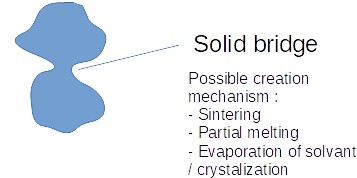
Solid bridges provide the highest structural integrity. They are formed via:
- Sintering: Particle merging via heat (below melting point).
- Partial Melting: Localized fusion at contact points.
- Crystallization: Dissolved solutes recrystallize during evaporation.
2.2 Adhesion and Cohesion Forces
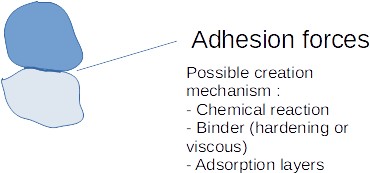
Viscous binders act as a matrix, sticking particles together. This is common in wet granulation where the binder creates a film around the particle surface.
2.3 Surface Tension and Capillary Forces: Liquid Bridges
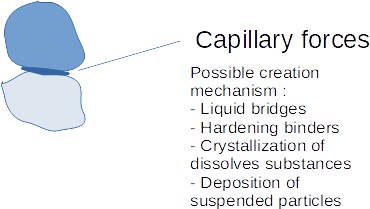
Free liquid (typically water) forms bridges at contact points. Capillary suction pressure ($P_c$) holds particles together, governed by surface tension ($\gamma$).
2.4 Mathematical Model: Rumpf Equation
The tensile strength of an agglomerate linked by bonding forces at coordination points is described by the Rumpf Equation:
\[ \sigma_t = \frac{1 - \epsilon}{\pi} \cdot \frac{k \cdot F_{bridge}}{d_p^2} \]Where:
- \(\sigma_t\): Tensile strength (Pa)
- \(\epsilon\): Porosity of the agglomerate
- \(k\): Coordination number (avg. number of contacts per particle)
- \(F_{bridge}\): Bonding force at the bridge (N)
- \(d_p\): Particle diameter (m)
Interactive Rumpf Agglomerate Strength Calculator
2.5 Interlocking
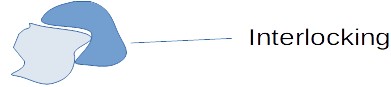
Mechanical interlocking occurs with irregular or fibrous particles. During compression, particles may deform or break, "enrolling" around neighbors to create mechanical bonds.
3. Factors Influencing Agglomeration
| Factors | Impact on Agglomeration |
|---|---|
| Particle Size | Smaller particles (\(d_p < 50 \mu m\)) have higher surface area/mass ratios, increasing bonding potential. |
| Moisture Content | Critical for liquid bridge formation. Over-saturation leads to a "slurry" state. |
| Binder Properties | Viscosity and wettability (contact angle) determine the strength of adhesion. |
