
Extrusion : an introduction
What is extrusion ?
How does an extruder work ?
Follow us on Twitter 
Question, remark ? Contact us at powder.process@protonmail.com
| Section summary |
|---|
| 1. What is a
hammer mill ? |
| 2. How does a
hammer mill work ? |
| 3. Industrial
hammer mills |
1. What is extrusion ?
Extrusion processes are used in various industries but especially in petrochemicals / plastics industry in order to compound plastics and produce pellets that can be used by a customer, or in food industries to manufacture edible pieces of different forms.
Extrusion consistent in transforming...
Extrusion is a very efficient process as several unit operations can happen in the same equipment : mixing, heating, melting, cooking, chemical reaction, granulation... It makes it however a process that can be difficult to control as it involves many chemical and physical transformations.
A typical extrusion process is made of the following steps :
- Raw material feeding : typically bulk solids (powders or pellets)
- Extrusion
- Die
- Granulation
Hammer mills are part of the impact mill familly, which means that the milling effect is obtained thanks to the speed at which particles are impacted, here, by one or several rotors.
2. How does a hammer mill work ?
Hammer mills are designed with a shaft on which are mounted several "hammers" which have most of the time the shape of thick plates. The shaft is rotating within a casing, and at the outlet of the mill is mounted a screen whose size will determine which particles are fine enough to leave the mill. The mill can be fed and discharged by gravity when using the mill as a crusher, while the milled products may actually be directly pneumatically conveyed, using the high amount of air moved by the mill, for fine milling applications.
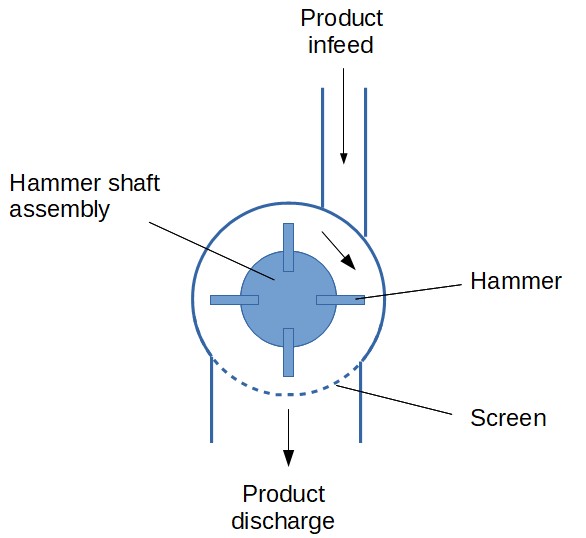
Figure 1 : Hammer mill components (gravity discharge)
2.1 Hammers
The number of hammers in a mill is variable, depending on the fineness looked after as well as the mill capacity, however, in general the higher the number of hammer, the finer will be the product, but the capacity will also decrease.
The mill can be more or less wide depending on the number of rows of hammers mounted on the shaft. Each row of hammer is separated from the other with a spacer plate.
The length of the hammers can also be adjusted. If the hammer length is increased, coming closer to the screen, the resulting product will be finer, however the capacity will decrease. Shorter hammers will produce a coarser product but will authorize a higher capacity.
Top
5 Most Popular
1.
Pneumatic transport design guide
2. Ribbon
blenders
3. Powder mixing
4. Hoppers design guide
5. Measuring degree of
mixing
--------------
 --------------
Top 5 New
1.
Continuous Dry Mixing
2. Mixing speed
3. Mixer cycle time optimization
4. Batch / continuous mixing
comparison
5. Energy Savings
2.2 Shaft speed
The 2nd key design and operational aspect for a hammer mill is the rotation speed. As the milling principle is based on the energy of the impact, the higher the speed, the finer the product can be expected as the particles will heat the hammer at high speed, but also be sent against each other or against the screen at high speed.
One must however be careful not to increase the speed without specific reason and care, as a high speed is increasing the energy input, temperature increase, and mechanical fatigue of the whole mill which can lead to intensified maintenance needs. Very high speed rotation will be reserved to soft materials for fine grinding while lower speed will be used to perform a crushing of larger / harder products.
2.3 Screen size
The screen size will help to control the particle size of the milled product by preventing that too large particles leave the mill before being comminuted. Reducing the screen size will thus help to reduce particle size distribution of the final product but it will come to the expense of the mill capacity.2.4 Drive
A hammer mill drive must be equipped with a frequency converter in order to be able to control the speed and thus adjust the capacity and resulting fineness of the materials.
2.5 Product feed
The feed to the mill must be controlled (at least roughly) by a dosing equipment such as a vibrating tube, a screw conveyor, or an airlock rotary valve. If the mill is wide, with several hammer rows separated by spacer plates, the feeding system must allow a good repartition of the feed all along the mill. As the mill will be requiring a lot of air, it is also key to have an air inlet.
2.6 Product discharge
If the mill is used as a crusher, which means that the particle size diameter of the finished product is quite coarse (>> 1 mm), then the mill can be discharged by gravity. However, for finer target sizes, requiring very high speed and thus moving a lot of air, the final product can be transferred pneumatically. In any case, it is necessary to consider the air requirements of the mill and foresee filters at air suction, and at air discharge (in the discharge hopper for gravity discharge, or in the receiving hopper after pneumatic conveying).
The air management in a hammer mill must be carefully studied, [Liu] mentions that if the air flow is incorrect a mill can lose up to 50% of its capacity. The following rule of thumb is given :
- 260 m3/h to 775 m3/h for 1 m2 of screen area
- 1350 m3/h to 2050 m3/h for 1 t/h of feed
These are only rule of thumbs, assistance from a mill supplied is mandatory for detail design.
2.7 Safety
Hammer mill have rotating elements, the hammers, at very high
speed (up to 120 m/s), thus the ingress of foreign bodies such as
metal particles can have severe mechanical and safety consequences
(dust explosions). The mill must therefore be protected by sieving
the feed and positioning a strong magnet or even a metal detector
at the inlet. The risk of dust explosion must also be adressed by
having a mill resistant to explosion, or by using protections
(explosion panels, suppression systems...).
3. Industrial hammer mills
Hammer mills are typically used in large industrial processes requiring a high throughput while guaranteeing relatively fine product.
Large
hammer mills can reach up to 20-50 t/h depending on the
expected granulometry (more fine, less capacity ; coarser,
larger capacity). Materials having a size up to 60 mm can be
grounded to ~1 mm, while, if the feed is already finer (10
mm), hammer mills can reach sizes less than 500 microns.