
Industrial Magnet Traps & Separators for Powder
A Complete Engineering Guide to Magnetic Separation & Inline Metal Extraction
Removing metal contaminants (foreign bodies) in powder and bulk solids materials using high-intensity permanent magnet separators
Follow us on Twitter

Question, remark ? Contact us at admin@powderprocess.net
| Section Summary |
|---|
| 1. Definition & Purpose |
| 2. Metal Foreign Bodies & Process Hazards |
| 3. Industrial Magnetic Separator Designs (Drawer, Rotary, Bullet, Plate) |
| 4. Magnetic Field Mechanics, Gradient & Flux Attenuation |
| 5. Interactive Separator Sizing & Capture Field Calculator |
| 6. Validation Protocols: Pull Testing & Gauss Meter Calibration |
| 7. Operational Troubleshooting & Demagnetization Risks |
| 8. Plant Engineering Rules of Thumb & Safety Limits |
This technical guide provides an in-depth operational and engineering overview of industrial magnet traps (grates, drawer magnets, rotary drum magnets, bullet magnets, and plate chutes) applied in dry bulk processing industries to capture metallic contamination, protect downstream equipment, and ensure strict food and pharmaceutical product safety.
1. Definition
What is a magnetic separator ?
Permanent magnets are used in process industries to separate foreign bodies from the bulk of good products. Foreign bodies, typically metallic parts like bolts, screws or just some metal shavings, can be detrimental to the process, by damaging (rotating) equipment, or to the final product. Implementing magnetic separation at different points of the process is an efficient solution to detect the presence of a metallic foreign body, remove it, or at least isolate a production suspected with contamination. Magnetic traps for food industry for instance, are very important to make sure no metal foreign body can be found by the end consumer, which could be a food safety hazard.
The article focuses on bulk solids handling and foreign matter control, but the notions introduced on magnets are still perfectly valid in liquid phase.
2. Metal Foreign Bodies control
How are used magnets in process industries ?
A foreign body is a solid piece of material of different nature than the product being processed. It can be anything from a plastic pen, to jewellery, to metallic pieces coming from an equipment that suffered a breakdown and released parts in the product flow (bolts, nuts, metal shavings if a rotating part has scratched a static one).
Foreign matters can have dire consequences for a factory. Their presence in the product being manufactured can lead to :
- Further mechanical damages : for example if a bolt gets caught in an Airlock rotary Valve the rotor tip may be damaged and scratch on the stator, leading to the breakdown of the valve, or even to the generation of metal shavings that constitute other foreign bodies.
- Safety concerns for the process : the introduction of a metal part in a high speed rotating equipment like a Mill can lead to sparks and to dust explosion if the conditions are met (see ATEX).
- Safety concerns for the consumer : if the product is sensitive, like food or pharmaceuticals, the presence of a foreign body can endanger the health of the consumer (ingestion of a metal part for example).
Magnetic separation of metal contaminants can be used to protect the process, the product and the consumer. A good understanding of magnet designs and magnet efficiency is necessary to efficiently select and use those equipment. Magnets are a central layer of defense for foreign bodies removal in process industries.
Top 5 Most Popular
1. Pneumatic transport design guide
2. Ribbon blenders
3. Powder mixing
4. Hoppers design guide
5. Measuring degree of mixing
--------------

--------------
Top 5 New
1. Continuous Dry Mixing
2. Mixing speed
3. Mixer cycle time optimization
4. Batch / continuous mixing comparison
5. Energy Savings
3. Industrial Magnetic Separation
What are the magnetic separator design available ?
Many permanent magnet design exists, however, only few of them are really useful in process industries :
| Magnet design | Use | Figure |
|---|---|---|
| Grate Magnets / Drawer Magnets | This is one of the most widespread and efficient design for magnetic separation. Several rods of magnets are disposed side by side, often with 2 layers. Product is free falling to the magnet. The denomination "drawer" means that the magnetic rods can easily be removed by pulling on them, like a drawer. | 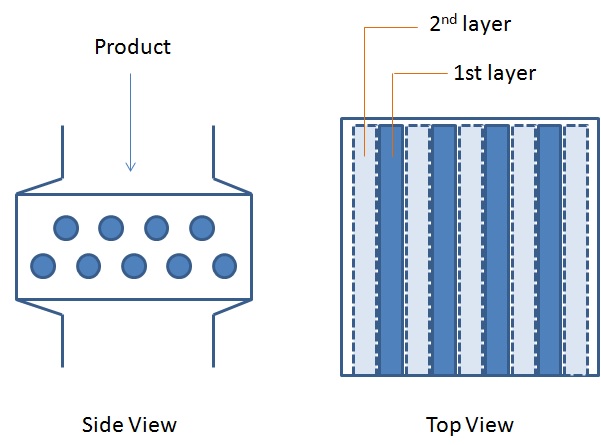 |
| Rotary Magnets / Drum Magnets | Drum magnets are made of magnetic rods disposed in concentric circles. The magnet is rotating and is supplied by material falling through it by gravity. Rotating magnets are often used to overcome bridging of powder over the rods. They have also generally a higher efficiency than static drawer magnets. | 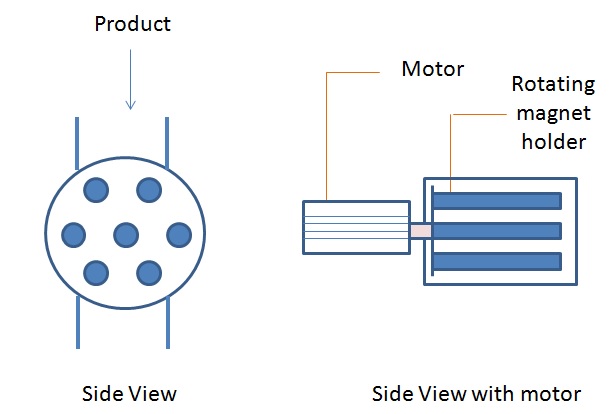 |
| Bullet magnets / inline magnets | Metal separation is often carried out in the powder free falling by gravity (see drawer magnets, rotary magnets) but it can be necessary to perform the metal detection in line a pneumatic conveying pipe. For this purpose, manufacturers have developed "bullet" magnets where a large magnetic rod (bullet) is positioned at the center of the pipe, the material having to flow around it. |  |
| Plate magnets (chute magnets) | Magnets can also be designed as plates. They are sometimes used prior to some machines (grinders especially) and often are in 2 parts taking a Z shape. The objective here being to force the product to flow as a thin layer and increase the area of contact with the plates. | 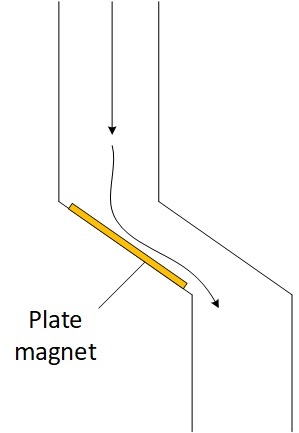 |
Magnetic separation can be used on powder / solids raw materials or on semi-finished product at any point of the process.
4. Creating the right magnetic field
How does a magnetic trap works ? How to make sure the magnet power is enough ?
For a magnet to actually separate metal contaminants, it must be designed to generate a strong magnetic field. The 1st design criteria is therefore the nature of the magnetic material. The material should be in rare earth and most specifically in Neodymium (NdFeB). Such material can generate up to 13500 Gauss (bare magnet), much higher than ferrite magnets (3000 Gauss) that should not be recommended for sensitive process industries.
The second important design criteria is the geometry of the magnet. Magnetic field decreases very quickly with the distance from the magnet. Therefore the magnet must be designed to ensure that the product flow remains very close to the magnet. For drawer magnets for example, it is achieved by having several tubes aligned closely (typically 50 mm center / center) and over 2 layers. Thus way it is ensured that the product will actually encounter a magnetic field strong enough to separate metals.
Mathematical Formulation of Magnetic Field Decay & Particle Retention
The magnetic flux density \(B(y)\) at a radial distance \(y\) away from the outer surface of a cylindrical magnet tube of radius \(r_0\) attenuates non-linearly. In practical engineering calculations, this decay is governed by the multipole cylindrical dipole expansion:
\[ B(y) = B_0 \cdot \left( \frac{r_0}{r_0 + y} \right)^n \]Where \(B_0\) is the measured surface magnetic flux density (Gauss or Tesla), \(r_0 = d_r / 2\) is the magnet tube outer radius, \(y\) is the clearance distance into the product stream, and \(n \approx 2\) to \(2.2\) for high-gradient rare-earth assemblies with alternating polarity pole pieces.
The translational magnetic force \(\mathbf{F}_{mag}\) exerted on a paramagnetic or ferromagnetic particulate of volume \(V_p\) and volumetric magnetic susceptibility \(\chi_p\) surrounded by a bulk matrix of susceptibility \(\chi_m\) is governed by the magnetic field gradient:
\[ \mathbf{F}_{mag} = \frac{V_p \cdot \Delta\chi}{\mu_0} (\mathbf{B} \cdot \nabla)\mathbf{B} = \frac{V_p \cdot (\chi_p - \chi_m)}{2 \mu_0} \nabla |\mathbf{B}|^2 \]Where \(\mu_0 = 4\pi \times 10^{-7} \text{ H/m}\) is the magnetic permeability of vacuum. For successful retention, \(\mathbf{F}_{mag}\) must decisively overcome the competing hydrodynamic drag force (\(\mathbf{F}_{drag}\)), inertial acceleration (\(m_p \cdot a\)), and gravity (\(\mathbf{F}_g\)):
\[ \mathbf{F}_{mag} \ge \mathbf{F}_{drag} + \mathbf{F}_g = 3\pi \mu d_p v_{rel} + m_p g \]The combination of the magnet strength and the geometry will result in a certain efficiency for the magnet. This efficiency is not the same for every metals since it will depend on the magnetic properties of the material to be separated. In a properly designed and operated static magnet, the following efficiencies should be expected :
- Carbon Steel : 100%
- Stainless Steel 304 : min 85%
- Stainless Steel 316 : min 70%
Efficiencies with a rotating magnet are usually higher ; with an inline magnet (conveying line), it can be lower.
5. Interactive Separator Sizing & Capture Field Calculator
Use the engineering tool below to simulate magnetic flux attenuation across the inter-tube gap, check powder superficial velocity against wash-off thresholds, and detect powder bridging risks.
Calculation Results & Hydrodynamic Analysis
6. Checking the magnet strength
How to measure the magnetic force of a magnet ?
It may be required to validate the strength of a magnet for compliance reasons, or to follow a potential loss of strength over time (especially if the magnet is operated at high temperature).
2 types of tests are commonly admitted : the pull test, in which the force required to remove a piece of metal from the magnet is measured ; and the use of a Gauss meter allowing to read the value of the magnet field.
- Gauss Meter (Hall Effect Probe) : Measures absolute magnetic flux density perpendicular to the tube skin. Proper technique requires sweeping a calibrated transverse probe axially along the tube surface to identify the peak magnetic polarity transitions (poles), where Gauss values reach maximum.
- Calibrated Pull Test Kit : Measures the mechanical break-away force required to pull an engineered ferrous test sphere (typically 1/4" or 1/2" diameter 416 stainless steel or carbon steel ball) off the magnet surface, measured via digital spring scale (lbs or kg). Pull force provides direct correlation to mechanical holding capability under powder product drag.
7. Common problems with magnet traps
Magnet traps are usually reliable equipment, however a certain number of issues may require some corrections :
Table 2 : common problems with magnet traps
| Issue | Root cause and action |
|---|---|
| Magnetic strength is decreasing with time | The magnet may be submitted to high temperatures - control the temperatures to which is exposed the magnet |
| The magnet strength seems below supplier specification | Make sure the gauss meter is used properly If the model is equipped with an extractor, test the magnet without the extractor |
| Powder accumulation and bridging over bars | Cohesive powder or gap between tubes is too tight. Replace static drawer with a rotating rotary magnet (drum) or increase center-to-center pitch. |
| Captured metal particles being washed off | Product flow velocity is excessive (\(v > 1.5\) m/s). Install flow deflectors, reduce chute free fall drop height, or use diverter baffles above tube gaps. |
Industrial Plant Engineering Rules of Thumb: Magnetic Separation
- Minimum Surface Gauss for Fine Metal Extraction: For tramp bolts and nuts, 3,000 to 5,000 Gauss is adequate. For fine abraded metal shavings, work-hardened SS 304, and wire fragments in food/pharma powders, specify high-energy Neodymium-Iron-Boron (NdFeB) rated at a minimum of 10,000 to 12,000 Gauss at the stainless steel sleeve surface.
- Maximum Velocity Limits to Prevent Wash-Off: In free-fall chutes, drop height directly above a static magnet grate should not exceed 0.5 m (20 in). If product impacts the rods at velocities exceeding 1.5 to 2.0 m/s, hydrodynamic drag will dislodge captured weakly magnetic particles (wash-off). In pneumatic conveying lines, inline bullet magnets should only be placed in slow-phase or low-velocity dilute systems (\(< 15\) m/s).
- Double-Row Staggering Geometry: Always install drawer grates with at least two staggered tube rows. The bottom row tubes must be precisely aligned below the clear gaps of the top row. An angle deflector bar (\(90^\circ\) inverted V-baffle) should be mounted directly above each upper rod to direct flow toward the high-gradient capture zones on the tube flanks.
- Thermal Coercivity Limits (Curie Temperature): Standard N-grade NdFeB permanently demagnetizes above 80°C (176°F). If process streams involve hot spray-dried powders, calcining, or hot air conveying, specify high-temperature grades: M (100°C), H (120°C), SH (150°C), UH (180°C), or EH (200°C), or switch to Samarium Cobalt (SmCo, up to 300°C).
- ATEX & Mechanical Spark Hazards: The presence of tramp steel striking high-speed mill hammers or rotary airlocks is a primary ignition source for combustible dust explosions. Placing a magnetic separator upstream of milling, fine classification, and pneumatic blower suction is an essential ATEX risk reduction measure (EN 1127-1). Grate housings must be electrically bonded and grounded (\(< 10\,\Omega\)) to avoid static spark discharge.
- Sanitary Sleeves & Easy-Clean Extractors: Always specify seamless 316L stainless steel outer sleeves with Ra \(< 0.8\,\mu\text{m}\). Quick-clean mechanisms that slide the internal magnetic cores out of stationary non-magnetic sleeves allow captured tramp metal to safely drop off without manual scraping hazards.
8. To know more about magnets
Magnetic filtering will allow to catch different contaminants in bulk solids industries, removing foreign bodies.
Magnets are a key components in a powder process to ensure reliability, safety of the installation and safety of the product. Magnetic separators allow to remove metal contaminants from bulk solids flows. Different design exist including rotary magnets or magnet drawers easily accessible for cleaning.
Please follow the link to get access to magnet theory and design details : All you need to know on industrial magnets for powder checking