
HFFS Horizontal Form Fill and Seal machines / Flow wrappers
(filling systems)
Principle of operation of Horizontal Form Fill and Seal machines
Question or remark ? Please contact us at admin@powderprocess.net
| Section summary |
|---|
| 1. Introduction |
| 2. Filling
sequence |
1. Introduction
Horizontal form fill and seal (HFFS) machines constitute the 2nd large family of filling machine, besides the Vertical filling machines. Those machines are used to pack big pieces in wraps (hence they are sometimes called flow wrappers) such as pizza, fruits, biscuits but can also be used for powder or chemicals such as detergent when having to use a standing pouch.
HFFS machines are automated to reach filling capacities relevant for industries and thus equipped with multiple components that must be activated in a coordinated way in order to have a proper filling. Those components are similar in function to those found in VFFS machines but ordered in a different way. As this type of machine is quite widespread in industries, engineers wishing to know more about HFFS machine will find in this page information regarding the filling sequence and the different design of fillers available in the market.
2. Filling sequence
How do Horizontal Form Fill Seal (HFFS) Packaging Machines Work?
2.1 HFFS components
An horizontal filling machine is made of the following sections :
- Infeed conveyor
- Forming area
- Film feeding and alignment
- Sealing and cutting
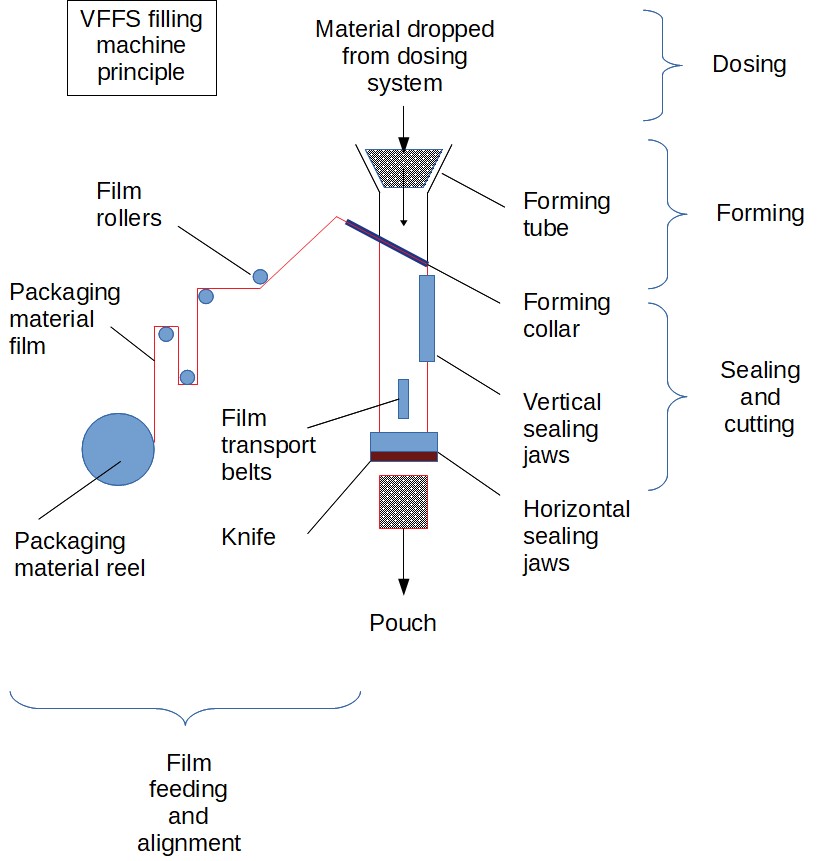
Figure 1 : Filling steps and
components of a typical VFFS machine
Top
5 Most Popular
1.
Pneumatic transport design guide
2. Ribbon
blenders
3. Powder mixing
4. Hoppers design guide
5. Measuring degree of
mixing
--------------
 --------------
Top 5 New
1. Continuous Dry
Mixing
2. Mixing speed
3. Mixer cycle time
optimization
4.
Batch / continuous mixing comparison
5. Energy Savings
2.2 Filling sequence
STEP 1 : the products to be packaged are brought to the filling area thanks to an infeed conveyor. The conveyor's function is to move the materials to pack in sequence towards the forming area but also to make sure the distance in between each product is kept constant and in line with the sealing and cutting operation after the material has been introduced in the pack.
STEP 1 : Packaging material unwinding
The packaging material, for example some aluminium foil, plastic laminate or even paper is delivered in rolls. The material must therefore be rolled out, or "unwinded" in order to be used. The film is pulled out and tensionned thanks to several rollers and a weighed pivot arm in order to be ready for a good forming. The unwinder is positioned at the back of the machine.
STEP 2 : Forming of the pouch
The material is fed flat and tensioned to the filling tube, however the shape of the pouch must be given to the packaging material in order to be able to perform the filling. It is done thanks to a specific part of the forming tube, called forming shoulder or forming collaer. The packaging material is then twisted around the forming tube and pulled all along the tube, which enables the next stages of the filling process.
Just after forming, some pull down belts are installed in order
to move the film (in some design, others use the sealing jaws to
pull the film).
Depends what is filled : large solids or power
Focus on powder
Then make an opening on other kind of materials
https://www.slideshare.net/peakequipment/bosch-guide-to-flow-wrapping
https://blog.syntegon.com/blog/2014/04/17/principle-of-operation-of-a-horizontal-flow-wrapper/
STEP 3 : Vertical sealing
Once the packaging material is well wrapped around the forming tube, then a 1st sealing, on the side, can be done. The forming collar and the width of the packaging reel must be such that there is an overlap when wrapping the material around the tube. A couple of sealing jaws, or sealing bars, is then used to press against each other the 2 parts of the overlapping material and weld them, often thanks to heating, to create a side seal. To be noted that there are different kind (shapes) of seals.
STEP 4 : Bottom sealing
The product cannot yet be fed to the filling tube as there is no bottom seal to the pouch. It is done by another couple of sealing bars that are also welding the material through pressure and heating.
The material is then pulled down by a length corresponding to the desired pouch length.
STEP 5 : Product filling
The dosing system positioned about the forming tube can finally be run in order to dose the amount of product to dose. The material falling down through the forming tube and inside the open pouch being manufactured.
STEP 6 : Top sealing
Once the dosing of product has been done, then the same sealing jaws that performed the bottom seal are activated again to, this time, create the top seal and close the pouch.
Note that for some design, the sealing jaws can also have a vertical movement up and down which allows to pull the film all along the machine and unroll it from the reel positioned on the unwinder.
STEP 7 : Cutting and discharge
After close the pouch, it is then cut and falls down to a collection system, typically a belt conveyor that brings the pouch to the next packaging step (putting in a box...)
2.3 Intermittent or continuous filling
For the simpler machines, the steps above are done sequentially. However, faster design allowing a continuous process, are also available with some suppliers.
Depending on the technology, manufacturers report filling speed of 30 to 80 pouch per minute for intermittent machines and 100-200 or even up to 300 pouch per minute for continuous machines.