
Hoppers and silos discharge rate calculations
Follow us on Twitter 
Question, remark ? Contact us at admin@powderprocess.net
| Section summary |
|---|
| 1. Aeration of
powders |
| 2. Permeability of
powders |
Knowing at which rate a hopper or a silo can be discharged by gravity is particularly interested for Engineers working with powders and other bulk solids as it allows to calculate cycle times and production line capacities.
1. Discharge rate calculation from actual observed data
Before engaging in models development, one must check if it is possible to define the discharge rate of a particular material from a hopper thanks to actual observations, for example in an existing silo.
The discharge rate can then be calculated thanks to :
m = (m1-m0)/(t1-t0)*3600
With :
m = mass discharge flow rate (kg/h)
m0 = mass of materials in the hopper at t0 (kg)
m2 = mass of materials in the hopper at t1 (kg)
t0 = time at which the discharge starts (s)
t1 = time at which the discharge stops (s)
The value calculated can then be used to estimate the discharge rate in new designs, or to perform cycle time calculations the particular silo considered. Be careful though to take several observations to average the actual discharging rate, and also to check how constant is the flow during the discharge (higher capacity at beginning of discharge than at the end).
Most of the time however, such actual observations are not available and the Engineer must calculate the discharge rate of hopper for a new project, or with a new material. Some models exist and can be used to estimate the rate of discharge by gravity of a material from a hopper.
2. Models to calculate the discharge rate from a hopper or a silo
2.1 Formula valid for coarse powders (typically > 400 microns)
2.1.1 Beverloo equation
Beverloo has proposed a formula to calculate the gravity flow discharge of bulk materials having a particle size distribution > 400 microns. The Berverloo formula is the following :

Top
5 Most Popular
1.
Pneumatic transport design guide
2. Ribbon
blenders
3. Powder mixing
4. Hoppers design guide
5. Measuring degree of
mixing
--------------
 --------------
Top 5 New
1. Continuous Dry
Mixing
2. Mixing speed
3. Mixer cycle time
optimization
4.
Batch / continuous mixing comparison
5. Energy Savings
Equation 4 : Beverloo equation (discharge rate through outlet for coarse particles)
With :
W discharge rate in kg/sC empirical discharge coefficient
k empirical shape coefficient
ρb is the bulk density in kg/m3
g is the acceleration of gravity 9.81 ms-2
dp is the particle diameter in m
d0 is the discharge diameter in m (note for no circular outlet, use hydraulic diameter 4*(cross sectional area)/(outlet perimeter)
C=f(ρb) and is in the range 0.55<C<0.65
k=f(particle shape, hopper angle) and is in the range 1<k<2
except for sand where it is 2.9
If acknown, consider C=0.58 and k=1.6
2.1.2 Johanson equation
Another method has been proposed by Johanson, still for coarse particles > 400 microns. Johanson's formula is the following :
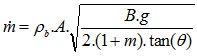
Equation 5 : Johanson equation (discharge rate through outlet for coarse particles)
With :
m_discharge discharge rate in kg/sθ angle of hopper deg
ρb bulk density in kg/m3
g is the acceleration of gravity 9.81 ms-2
Table 1 : Parameters for Johanson equation
| Parameter | Conical hopper | Wedge hopper |
|---|---|---|
| B | D, diameter of outlet | W |
| A | Pi*D^2/4 | WL |
| m | 1 | 0 |
2.1.4 Mehos equation
The following formula can be used for assessing the discharge rate of coarse powders :
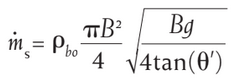
With :
ms = hopper discharge rate in kg/sB = outlet diameter of the hopper in m
ρbo = powder bulk density at outlet conditions in kg/m3
θ' =mass flow hopper angle in deg
2.2 Formula valid for fine powders (< 400 microns)
2.2.1 Carleton equation
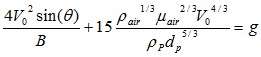

Equation 6 : Carleton equation (discharge rate through outlet for fine particles)
V0 average velocity of solids dichargingA,B given above
ρp particle density
2.2.2 Mehos equation
Fine powder flow is generally lower than the flow of coarse powder. The fluidization and air balancing - flow of air from downstream to top - being detrimental to the mass flowrate of powder.
The following formula can be used to assess the discharge rate of fine powders.
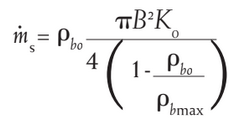
ms = hopper discharge rate in kg/s
B = outlet diameter of the hopper in m
ρbo = powder bulk density at outlet conditions, flowing in kg/m3
ρbmax = powder bulk density at the major consolidation stress in the hopper in kg/m3

h = depth of powder in the cylinder section in m
k = Janssen coefficient, if unknown can be assumed at 0.4 as 1st approximation
Φ' is the wall friction angle in deg
σ1 = major consolidation stress
2.4 Excel calculation tool
Sources
[Rhodes] Principles of Powder Technology, page 123, Rhodes, Wiley, 1990