
Apparent Particle Density
Follow us on Twitter 
Question, remark? Contact us at admin@powderprocess.net
1. Pneumatic transport guide
2. Ribbon blenders
3. Powder mixing
4. Hoppers design guide
5. Degree of mixing
--------------
 --------------
1. Definition
What is the apparent particle density?
The apparent particle density (often simply called particle density) is the density of individual particles, including their internal porosity. It is distinct from the skeletal density (which excludes pores) and the bulk density (which includes the voids between different particles).
2. Calculation
How to calculate the apparent particle density?
The fundamental definition is the mass of a single particle divided by its total volume (including internal closed or open pores):
\[ \rho_p = \frac{\text{mass of a particle}}{\text{volume of a particle}} \]

Equation 1: Apparent particle density
3. Measurement & Relationship
How to measure the apparent particle density?
It is possible to determine the apparent particle density from the Skeletal density and the internal porosity (pore volume), which are typically measured via gas pycnometry or mercury porosimetry.
\[ \frac{1}{\rho_p} = \frac{1}{\rho_{sk}} + \omega_p \]
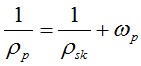
Equation 2: Relationship between Apparent Density, Skeletal Density, and Porosity
With:
\(\rho_p\) = apparent particle density (kg/m³)
\(\rho_{sk}\) = skeletal density (kg/m³)
\(\omega_p\) = specific pore volume (m³/kg)
Apparent Particle Density Calculator
Engineering Rules of Thumb
- Typical Values: For non-porous materials like sand or glass beads, \(\rho_p \approx \rho_{sk}\). For porous catalysts or expanded minerals, \(\rho_p\) can be 40-70% of \(\rho_{sk}\).
- Unit Conversion Tip: Porosity \(\omega_p\) is often reported in cm³/g. To use in SI formulas (m³/kg), multiply by \(10^{-3}\).
- Validation: Apparent density must always be less than or equal to skeletal density. If your calculation shows otherwise, check your pore volume units.
- Application: Use apparent particle density for Calculating terminal velocity in pneumatic conveying or sizing fluidized beds. Using bulk density instead will lead to massive design errors.
4. Application
Why measuring the apparent particle density?
The particle density is critical in applications requiring fluidization of particles or their suspension. It directly influences the terminal velocity of the particles in a gas stream. In cyclone design, pneumatic conveying, and gas-solid separations, the apparent density (not the bulk density) is the governing physical property for aerodynamic behavior.