
Double Shaft Paddle Mixers for powder mixing
Mixing principle, design, operation, applications & interactive sizing tool
Follow us on Twitter
Question, remark ? Contact us at admin@powderprocess.net
| Section summary |
|---|
| 1. Introduction |
| 2. Mixing principle of double shaft paddle mixers (with fluidization zone) |
| 3. Mixing operating parameters |
| 4. Detailed specifications |
| 5. Mixer sizing & Interactive Calculator |
| 6. Specialized Applications |
| 7. Engineering Best Practices & FAQ |
1. Introduction
Industrial double shaft paddle mixers have been a design of choice for process industries over the last 30 years for bulk solids dry Mixing. They offer many advantages vs other Mixers design thanks to the mixing principle based on the mixture fluidization, especially a short mixing time and a gentle handling of the product which can be attractive in applications requiring high capacity and to avoid damaging the ingredients.
This webpage is focusing in the detail design of :
- Batch paddle mixers
- And more especially batch double shafts paddle mixer reaching a speed high enough to fluidize the materials to be mixed (also called twin shaft paddle mixer or fluidized bed mixers). Most of the concepts are also valid for continuous twin shafts paddle mixers.
Note that alternative design of paddle mixers also exist :
- Single shaft paddle mixer : the mixing principle is different than double shaft paddle mixers and situated somehow in between ribbon blenders and ploughshare mixers.
- Double shaft paddle mixer - non fluidizing : double shaft paddle mixers are used especially for cement mixing but without creating a fluidizing zone, the mixing is then convective but with a low Froude number.
2. Mixing principle of double shaft paddle mixers (with
fluidization zone)
Double shaft paddle mixers are convective mixers : the mixer is equipped with 2 agitators mounted with paddles that actively displace the powder.
For the mixing to be efficient, a certain speed of rotation of the shaft must be reached. At this speed, the paddles are able to lift the solid and create a fluidization of the product in the central area of the mixer, which explains the denomination sometimes found in literature of fluidized bed mixers. This zone, called fluidization zone, is the area where mixing actually takes place. Paddle mixers have also profiled paddles with a defined angle promoting both radial and axial mixing, thus optimizing the total mixing time.

Figure 1 : Fluidization zone in double shaft paddle mixer
The mixing speed, at which the mixing is optimal, is reached when the Froude number is greater than 1. At such a Froude number, the inertia is high enough to overcome the gravity acting on the solids particles, which allows the paddles to lift the solids and create the fluidization area. It is not necessary, and not desirable, to run a double shaft paddle mixer at Froude number higher than 1-1.1, the mixing time will not be reduced much and the energy inputs to the solids will degrade it (breakage of particles).
Top
5 Most Popular
1.
Pneumatic transport design guide
2. Ribbon
blenders
3. Powder mixing
4. Hoppers design guide
5. Measuring degree of
mixing
Top 5 New
1. Continuous Dry Mixing
2. Mixing speed
3. Mixer cycle time
optimization
4. Batch
/ continuous mixing comparison
5. Energy Savings
The optimal mixing speed for a particular mixer can be calculated, knowing the diameter of the mixing tool, and posing Fr=1.1
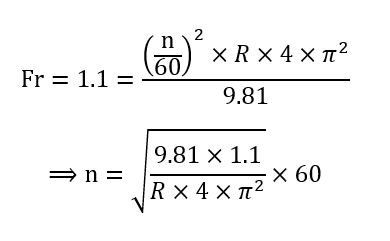
Equation 1 : Calculation of the required mixing speed for a double shaft paddle mixer
With :
- \(R\) is the radius of the mixing tool (center of shaft to tip of
paddle) in m
- \(n\) is the mixing speed in rpm
Double shaft paddle mixers can also be used to mix a small quantity of liquid within the powder, typically to have a light agglomeration effect. This injection should not exceed few % of the batch weight in order not to create lumps. For higher percentages it is however possible to fit those mixers with deaglomerators, small choppers turning at high speed and providing a shearing effect to break lumps that may be formed during the injection of liquid and mixing.
3. Mixing operating parameters
For industrial double shaft paddle mixers, the mixing time is typically 30s to 2-3 min, going longer than this, with a dry-mix, means that something in the setting of the mixer is not correct.
The mixer performance, i.e. time to reach a desired homogeneity, is a function of the following operating parameters :
- Mixing batch size : min 30-40% of mixer total volume / max 70-80% of mixer total volume
- Mixing speed : calculated and set to reach Fr=1-1.1
- Small and Minor ingredients to be introduced in the mixer after the main ingredients (or in sandwich), preferably in the central area of the mixer
The mixture desired homogeneity must be set by the final operator of the mixer and tested during the qualification of the double shaft paddle mixer. Sampling and analysis are performed.
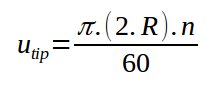
Equation 2 : Calculation of mixing tool tip speed
With :
- \(R\) is the radius of the mixing tool (center of shaft to tip of
paddle) in m
- \(n\) is the mixing speed in rpm
4. Detailed specifications
Mixer access
The ease of access is generally considered as one of the strong points of twin shaft paddle mixers.
Depending on the manufacturers, the following options may be ordered, sorted by easiness of access for the operators :
- Extractible shafts
- Front door
- Side doors
- Opening top cover
Most of the double shaft paddle mixers available on the market have the shafts supported on both ends by bearings. However, some constructors propose also the option to have cantilevered shafts (bearings on 1 side only), which constitutes an advantage for hygienic applications (food and pharma) by allowing to extract the shaft and leave the inside of the mixer free for an easy cleaning.
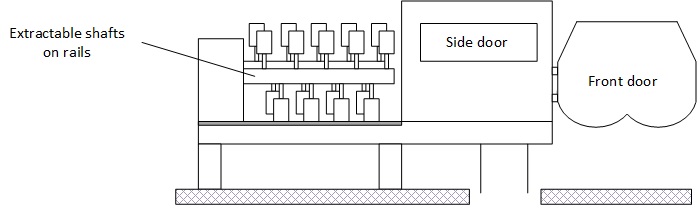
Figure 2 : Accessibility options for double shaft paddle mixer (hygienic execution)
Options can be ordered together or 1 by 1.
Discharge valves
3 types of discharge valves can be found on the market, depending on the suppliers and the need of the customer. There can be 1 or 2 valves per mixer :
- Simple flap valves : discharge valves have a rectangular shape. It is the most common design.
- Hygienic round discharge valve : the valve has a round shape and, once closed, mimimizes the gaps where product can settle and avoid being mixed, contrary to the 1st type of valve that is presenting higher gaps. Those valves have a limited size that can increase the discharge time and thus reduce the mixer capacity.
- Bomb doors : the bottom of the mixer can entirely be opened by large flaps. The key advantage is that the mixing time is very short (less than 30 s), and that the quantity of product remaining in the mixer is very low. However, one must be careful to the tightness of the doors once closed, as well as to the access for cleaning below the doors.
Depending on the technology chosen, the mixer will discharge in a hopper that will be entirely connected to the mixer bomb doors, or to a separate hopper connected through a short pipe to the mixer.
Instrumentation
The following instrumentation can be found on twin shaft paddle mixers :
- Speed sensor : allows to confirm rotation and speed of the shafts
- Temperature sensors : positionned on the bearings, allow to detect abnormal heating due to broken bearings
- Flowmeter : positionned on the compressed air supply to bearing seal flush. Bearing seal flush constitute an important function to avoid ingress of product to the bearings, which would damage them or make the powder burn, which would constitute an ignition source causing dust explosion.
- Valve position sensor : allows to detect that the discharge valve is closed
- Locks : placed on each access door, ensure the safety of the machine by preventing operator to access the mixer while it runs, or start the mixer if an access point is opened.
Dust explosion (ATEX)
In order to process powders, double shaft paddle mixers, which are mixing with a mixing tool tip speed > 1 m/s, must present the following characteristics :
- Clearance in between the tip of paddles and the mixer body must be > 4 to 5 mm
- The bearing seals must be pressurized
- During loading and discharge, the mixer speed must be such that the tip speed of the paddles is < 1 m/s
The paddle tip speed can be calculated thanks to equation 2 above.
5. Solids mixer sizing
The mixer should be the bottleneck of the installation of mixing, which means that it should not be slowed down by the process section upstream or downstream. The capacity of the installation should be a given and a batch size should be chosen in consequence, considering as well an estimated number of batches / h
Batch size (kg) = Capacity (kg/h) / Number batches per hour (/h)
The mixing process being actually volumetric, it is necessary to know the untapped (loose) density of the mixture to size properly the mixer.
Batch size (l) = Batch size (kg) / Loose density mix (kg/l)
On top of this, it is critical to consider that the system should never be filled at 100% of its capacity, in order to allow space for particles movement.
Total mixer size (l) = Batch size (l) / 0.7
Mixers have maximum filling coefficient in between 0.65 to 0.8 usually.
⚡ Double Shaft Paddle Mixer Sizing & Speed Tool
💡 Practical Plant Engineering Rules of Thumb & Safety Limits
- Fluidization Sweet Spot (\(\mathrm{Fr} \approx 1.05 - 1.1\)): Never oversize the gearmotor speed to push \(\mathrm{Fr} > 1.3\). Centrifugal pinning against the trough walls prevents axial return, dramatically worsening homogeneity while accelerating paddle wear.
- Liquid Addition Thresholds: Up to 3–5% liquid can be evenly dispersed using high-pressure atomizing spray nozzles directed into the weightless center fluidization zone. Exceeding 5% requires internal high-speed pin de-agglomerators (choppers) running at 1500–3000 rpm to eliminate wet agglomerates.
- Fill Volume Boundaries: Optimal performance lies between 60% and 70% gross volume. Operating below 30% starves the inter-shaft fluidized exchange; filling above 80% chokes particle lofting and forces the blender into inefficient, high-power convective sliding.
- Bomb-Door Discharge Maintenance: While drop-bottom bomb doors achieve full batch emptying in 10–25 seconds with residual powder <0.1%, inflatable perimeter elastomeric seals must be inspected weekly for particulate binding to prevent product leakage.
- ATEX Ignition Mitigation: Because paddle mixers typically run at tip speeds between 1.5 and 3 m/s, paddle-to-housing gaps must never fall below 4–5 mm to prevent mechanical friction sparks. Shaft glands must feature continuous air or nitrogen flushes monitored with low-pressure interlocks.
Applications of double shaft paddle mixers : What is a paddle mixer used for ?
Double shaft paddle mixers, thanks to their working principle based on fluidization, find a lot of applications in industries where a good level of homogeneity is required with possibility to disperse minor ingredients <0.1% while having a gentle mix and short mixing time :
- Pharmaceuticals : mixing active principles
- Baby food : infant formula or infant cereals
- Food : ready to prepare mixes like coffee, cocoa...
- Food ingredients : flavors, premix
- Chemicals : mixing of reactants, premix
Some executions are however found in other industries, like in construction (can you mix cement with a paddle mixer...), environment or agriculture / animal feed / aqua feed
Double shaft paddle mixers for sale : how to select a second hand (used) mixer ?
Many used ribbon blenders can be found on the market. When looking for a 2nd hand mixer, you should go through the following checks :
- Was the paddle mixer used for a similar application to your needs ?
- Look for damages on the paddles, scratches on the inside of the shell, measure the gap in between each paddle and the housing, there should not be metal metal contact
- Run the mixer, listen to the bearings, if possible measure vibrations
- If necessary, can the mixer be cleaned ?
- Can the cover be modified to accomodate your needs for the fittings
- Is the discharge valve functional
- Test all instrumentation that may be coming with the mixer
- Is the mixer ATEX compliant (dust explosion risks) for the area you defined, if not can it be retrofitted
6. Specialized Applications of Double Shaft Paddle Mixers
Double shaft paddle mixers demonstrate remarkable versatility, finding utility in a spectrum of specialized applications across distinct industries :
- Pharmaceutical Industry : In pharmaceutical settings, these mixers are indispensable for achieving the stringent homogeneity required in medicinal formulations. The ability to gently blend active principles ensures that pharmaceutical products maintain consistency and efficacy.
- Food Industry : Renowned for their gentle yet thorough mixing, double shaft paddle mixers play a key role in the food industry. From crafting ready-to-use mixes like coffee and cocoa to blending ingredients in the production of various food products, these mixers contribute to the uniformity and quality demanded by the food sector.
- Chemical Sector : The chemical industry benefits significantly from the precision offered by double shaft paddle mixers in the mixing of reactants and premixes. The reliable and thorough blending of ingredients contributes to the chemical sector's need for accurate and consistent results.
- Construction and Environmental Processes : Beyond traditional applications, double shaft paddle mixers find use in construction projects and environmental processes. Their adaptability makes them valuable for tasks such as mixing cement and contributing to environmental solutions, showcasing the versatility of these mixers. Double shaft paddle mixers may however not be fluidizing in these applications.
- Agriculture and Animal Feed : In agriculture, animal feed, and aqua feed industries, double shaft paddle mixers are employed for their ability to handle various dry ingredients efficiently. This includes blending feed components to ensure a balanced diet for livestock and aquaculture.